Scrap Gold Calculator: Find Out What Your Gold Is Really Worth
You pulled out an old gold chain that snapped years ago. Or maybe a ring that no longer fits, a handful of mismatched earrings collecting dust in a drawer. You know it has value. But when you walk into a pawn shop or call a local buyer, you have no idea if the number they quote is fair or not.
That is the exact problem most people face before they search for a scrap gold calculator. They do not know what their gold is actually worth. And without a real number to work with, they end up accepting whatever offer comes their way.
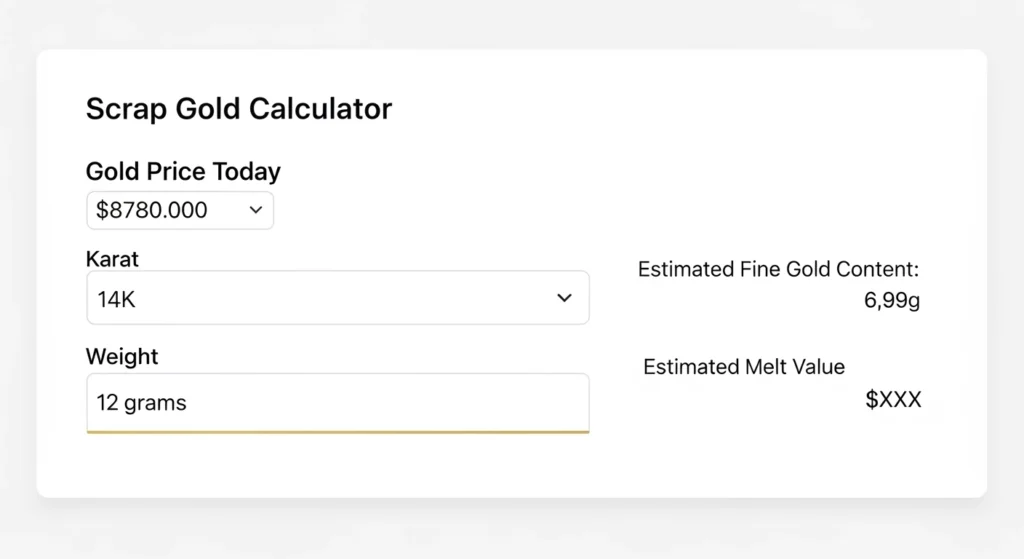
This online scrap gold calculator gives you a live, karat-specific melt value estimate based on the current gold spot price. Enter your weight, select your karat, and you get a number you can actually use.
Scrap Gold Calculator
Enter Weight by Karat
| Karat | Purity | Weight (g) | Value |
|---|
Gross Weight: 0.00 g
Dealer Configuration
What Will Buyers Pay You?
| Karat | Purity | Stamp | Common Use |
|---|---|---|---|
| 24K | 99.9% | 999 | Bullion, investment gold |
| 22K | 91.7% | 916 | South Asian jewelry, coins |
| 18K | 75.0% | 750 | European fine jewelry |
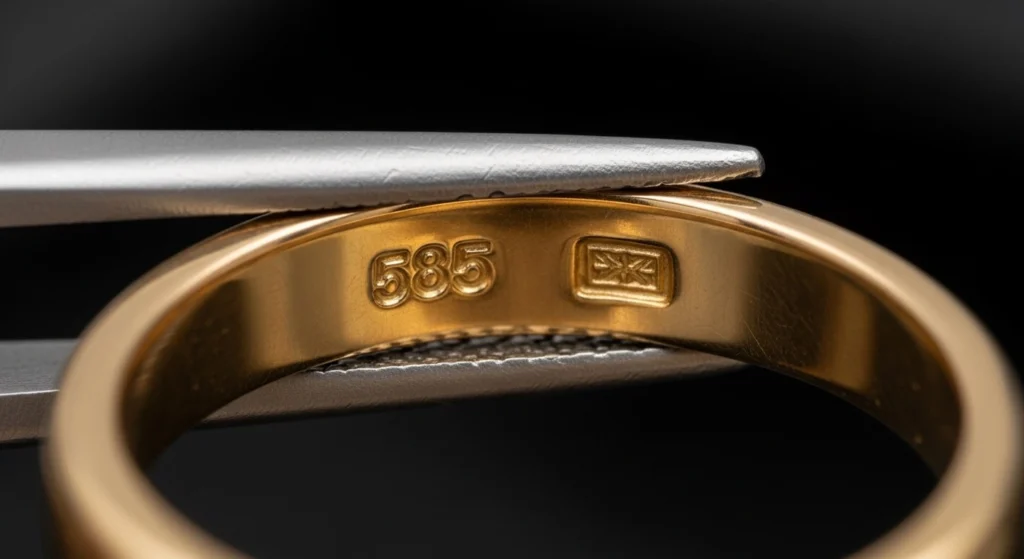
| 14K | 58.3% | 585 | US fine jewelry |
| 10K | 41.7% | 417 | US fashion jewelry |
| 9K | 37.5% | 375 | UK jewelry |
What Is Scrap Gold and Why Does It Have a Melt Value?
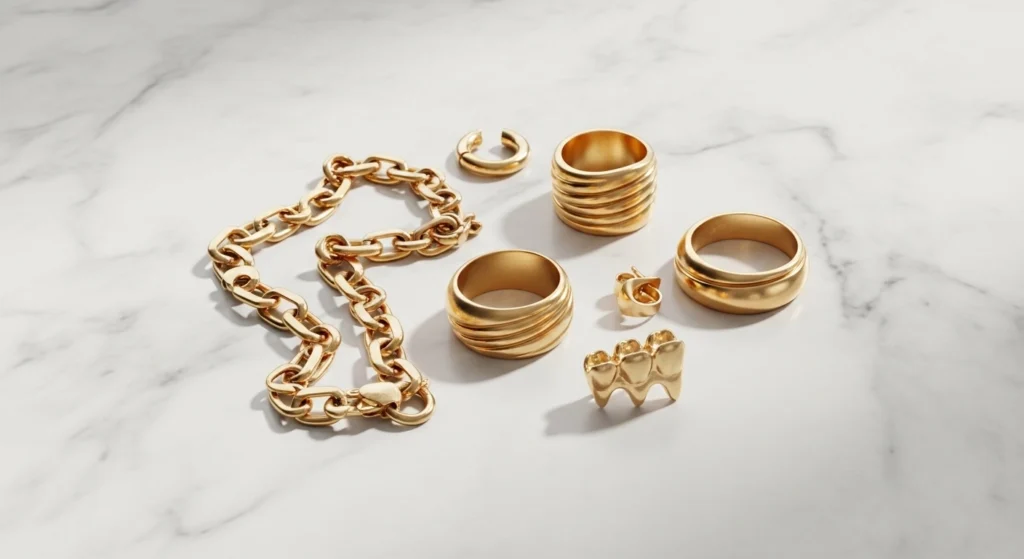
Scrap gold is any gold item that no longer holds value in its original form. It is gold that has moved past its useful life as a product, whether that means a broken bracelet, a bent ring shank, a removed dental crown, or a damaged coin that no longer carries collectable appeal.
These items get valued on one thing only: the gold they contain. Not the design. Not the craftsmanship. Just the raw gold content. That number is called the melt value, and it represents what the gold itself is worth when melted down and refined into pure metal.
The scrap gold value calculator on this page calculates exactly that. It takes your weight, applies the purity percentage for your karat, and multiplies it by the live gold spot price. The result tells you the intrinsic value of what you are holding.
What Counts as Scrap Gold?
People sell scrap gold in many forms. Some of the most common include:
- Broken or damaged jewellery: chains, rings, bracelets, earrings
- Gold dental work: crowns, bridges, fillings
- Old watches with gold cases or bands
- Coins that have lost collectable value and are sold for their metal content
- Electronic scrap gold from industries
- Gold-filled items where the outer layer can be separated and assessed
If it contains white gold and you no longer want it as an object, it qualifies as white gold scrap. The gold scrap calculator handles all of these, as long as you know the karat and weight. We also provide specialized valuations for items with lower precious metal content, such as gold filled scrap value.
Using this online scrap gold calculator takes less than a minute. Follow these steps:
Step 1:
Check the Gold Price Today field at the top of the calculator. It pre-fills with the current spot price, but you can update it manually if needed.
Step 2:
Select your unit of measurement from the dropdown. Options include grams, pennyweight (dwt), and troy ounces.
Step 3:
Enter the weight of your gold for each karat level in the left-hand column. If you have multiple pieces of different karats, enter them separately in the corresponding karat rows.
Step 4:
Read your results on the right side under the Dealer’s Buying Guide. You will see total weight, estimated fine gold content, estimated payable gold content, and the estimated payable value per unit.
Step 5:
Use the Target Profitability slider if you are a dealer or jeweller buying pieces for resale. This adjusts the suggested target purchase price based on your desired margin and shows your estimated profit.
Refer to our page for a detailed guide on how to use the gold scrap calculator accurately.
How to Check Your Gold's Karat Before Using the Calculator
The karat you enter determines the entire calculation. A wrong karat gives you a wrong melt value. So before you input anything into the scrap gold value calculator, spend a minute confirming what you actually have.
Look for the Hallmark Stamp
Most gold jewellery carries a small hallmark stamped somewhere on the piece. On rings, check the inside of the band. On necklaces and bracelets, look near the clasp. Earrings often have a stamp on the post or the back.
4K gold (58.5% pure)
18K gold (75% pure)
10K gold (41.6% pure)
22K gold (91.6% pure)
24K fine gold (99.9% pure)
Gold-filled or gold-plated
Testing Methods for Unknown Karats
You apply a small drop of acid to a scratch mark made on a testing stone and watch how the gold reacts. Different acid strengths test for different karats, and the colour change tells you where the gold falls.
are faster and more accessible than they used to be. Many jewellers and pawnbrokers use them routinely. They measure electrical conductivity and give a karat reading in seconds.
Professional refiners use this along with fire assay, which involves melting a small sample to measure the actual gold content.
How the Scrap Gold Calculator Works
The math behind a scrap gold melt calculator is straightforward, but you need three pieces of information to get an accurate result:
Every karat of gold corresponds to a specific purity percentage. That percentage tells you how much of the item’s weight is actual gold, as opposed to other metals used in the alloy. The calculator takes that percentage, multiplies it by the weight you entered, and then multiplies the result by the live gold price per gram. That final number is your melt value, also called the gold scrap value.
Why the Live Gold Price Changes Your Result Significantly
Gold is a traded commodity. Its price moves every single business day based on market forces, currency strength, inflation data, geopolitical events, and investor demand. A calculator pulling yesterday’s price can give you a number that is off by several dollars per gram.
That might sound small, but if you are dealing with 50 grams of 18K gold, even a five-dollar-per-gram difference adds up to a meaningful gap in your estimated value.
The Scrap Gold Calculation Formula
The formula used in every reliable gold melt value calculator looks like this:
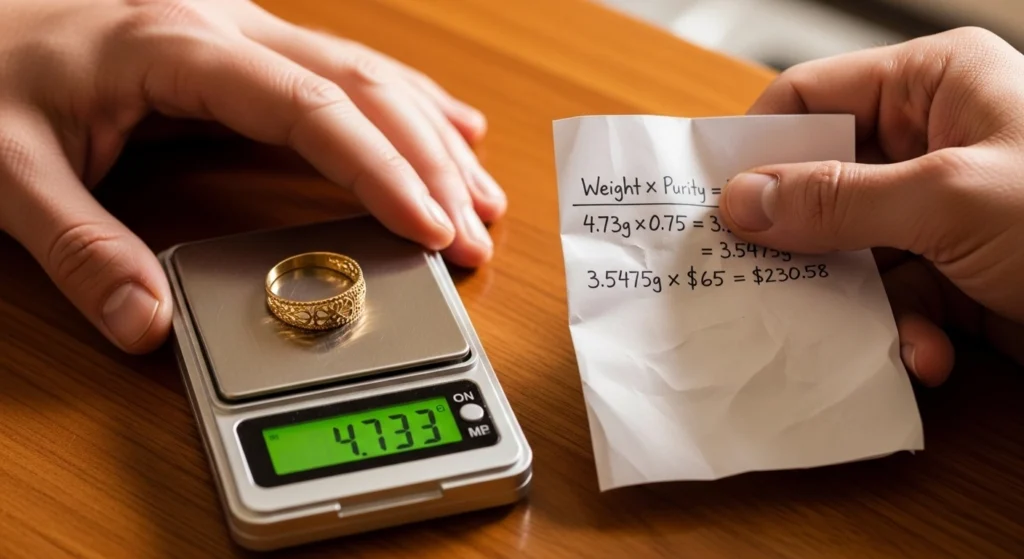
Weight (in grams) x Purity % x Current Spot Price per gram = Melt Value
So if you have 10 grams of 14K gold, the calculation runs as: 10 x 0.583 x current price per gram. That gives you the pure gold value of that piece. The higher the karat, the more gold is in the item, and the higher the melt value per gram.
- 10K = 41.7% pure gold
- 14K = 58.3% pure gold
- 18K = 75.0% pure gold
- 22K = 91.7% pure gold
- 24K = 99.9% pure gold
Scrap Gold Prices by Karat: What Each Type Is Worth
Not all gold is equal when it comes to scrap. The karat tells you how much pure gold is actually in the piece, and that directly determines the value. A 10K ring and an 18K ring of the same weight will yield very different scrap gold prices because the 18K ring contains nearly twice the gold content. In order to calculate the accurate value of your gold, you need to learn about gold scrap karats guide, purity, stamps, and calculator inputs, etc.
Here is a breakdown of the four most common karats you will encounter when calculating scrap gold value:
Karat | Purity % | Common Uses | Relative Scrap Value |
10K | 41.7% | Every day, US jewellery, fashion pieces | Lowest scrap value per gram |
14K | 58.3% | Most US fine jewellery, engagement rings | Mid-range scrap value per gram |
18K | 75.0% | High-end fine jewellery, European pieces | High scrap value per gram |
22K | 91.7% | Coins, some South Asian jewellery | Very high scrap value per gram |
24K | 99.9% | Bullion bars, investment gold | Highest scrap value per gram |
14K Gold Scrap Value Per Gram: The Most Common Karat in the US
If you are selling jewellery in the United States, there is a good chance it is 14K. It is the most widely used gold alloy in American fine jewellery because it balances durability with a reasonable gold content. At 58.3% purity, 14K gold delivers a solid melt value without being as soft as higher-karat pieces.
When you run a 14K gold scrap calculator estimate, the result reflects just over half of the total weight as pure gold. So for every 10 grams you enter, roughly 5.83 grams of that counts toward your melt value. Use the 14 karat gold scrap calculator above and enter your exact weight to get the current dollar figure based on today’s gold scrap price.
18K, 10K, and 24K: How They Compare
is common in fine jewellery, particularly pieces made in Europe and Asia. At 75% purity, it gives you noticeably more gold content per gram than 14K. Items that feel heavier and more yellow in colour often turn out to be 18K.
is the legal minimum for gold jewellery in the United States. It is the most durable option because of its high alloy content, but it also produces the lowest scrap value per gram. It is still worth selling since the gold content adds up quickly with weight.
is as close to pure gold as you get. Bullion bars and investment coins are usually 24K. These pieces have the highest melt value per gram, but they are also rarely found as broken jewellery. If you have 24K items, the scrap value and the bullion value are very close to each other, which makes the decision to refine versus sell straightforward.
This is a point that trips up a lot of people. Gold scrap and gold bullion are both made of gold, but they are priced and traded very differently.
Scrap gold gets valued at its melt content only. The form it comes in does not matter. A broken necklace and a bent ring both get melted down and refined. What you receive reflects the gold inside, minus any refining costs and margins the buyer applies.
Bullion is a different thing. A government-minted gold coin or a certified gold bar trades at or above the spot price because of its recognised form, guaranteed purity, and immediate liquidity. You do not have to send it for assay. Any buyer can verify it by sight. That trust commands a premium. For a detailed breakdown of key differences, read our gold scrap vs bullion value guide.
Factor | Scrap Gold | Gold Bullion |
How it’s valued | Melt value only (gold content) | Spot price plus premium |
Common forms | Jewellery, dental, and industrial | Coins, bars, rounds |
Typical payout vs spot | 70% to 95% of the spot price | At or above spot price |
Needs refining? | Yes, before final settlement | No, immediately tradeable |
Best for | Sellers recycling unwanted gold | Investors and collectors |
Our calculator bridges both worlds. Beyond calculating scrap gold value, it also helps you estimate what bullion products you can acquire through scrap exchanges or direct purchases, whether that is fine gold grain, privately minted rounds, or sovereign gold and silver products. That makes it useful not just for one-time sellers but also for dealers who regularly rotate between scrap and bullion. Find out the market worth of old medical pieces by calculating your dental gold scrap.
Be sure to identify items that only hold a thin gold platted scrap value before mixing them with solid alloys.
What Your Actual Scrap Gold Payout Will Look Like
Your melt value and your cash offer are two different numbers, and you need to understand why.
The melt value your scrap gold calculator shows represents 100% of the gold content at the spot price. No buyer in the world pays you 100% of that number. They cannot. They have real costs on their side: refining fees, assay testing, shipping and insurance, labour, and business overhead. On top of that, they need to make a margin to stay in business.
What you should expect in practice depends on who you sell to. Refineries working with higher volume dealers tend to settle closer to the top end of the range. One-off sellers at pawn shops tend to receive offers toward the lower end. Knowing the spread helps you evaluate any offer before you accept it.
Convenient but often lower rates
Varies widely by buyer
Competitive but requires shipping
Best rates, usually dealer-focused
Why Buyers Pay Less Than the Spot Price
It comes down to costs and risk. When a buyer takes your scrap gold, they do not immediately receive the spot price for it. They have to test it to confirm purity, melt it down, and refine it into pure metal before it has tradeable value again. Each step has a cost. Add in the overhead of running a physical location or a mail-in operation, and a 10 to 30 per cent deduction from melt value is completely standard.
An offer below 60 or 65 percent of your calculated melt value is worth questioning. Not all low offers reflect bad faith, but you deserve a clear explanation of what deductions are being applied and why.
How to Negotiate With Your Calculator Result
- Walk in with your number. Run the scrap gold per gram calculator before any meeting or phone call.
- When a buyer makes an offer, you can immediately compare it as a percentage of what you know the melt value to be.
- If they offer 75 per cent, you know exactly what you are leaving on the table and whether it is worth getting a second quote. Buyers tend to sharpen their offers when they see you have done your homework.
Gold-Filled Scrap: Why It Calculates Differently
Gold-filled jewellery is not the same as solid gold, and it does not calculate the same way in a standard scrap gold melt calculator.
Gold-filled items have a solid layer of gold mechanically bonded to a base metal core, usually brass or copper. The gold is real, and it has real value. But the total weight of the item includes the base metal, too. A standard scrap calculator that uses the full item weight and applies a karat purity will give you an inflated number if you do not account for the fill ratio.
Read the fill stamp
Look for stamps like 1/10 14K GF or 1/20 12K GF. These tell you the fraction of the total weight that is the gold layer. 1/10 14K GF means one-tenth of the item’s weight is 14K gold. So for a 10-gram item with that stamp, you are working with 1 gram of 14K gold, not 10 grams.
Calculate based on the actual gold weight, not the full item weight. Use the gold-filled scrap calculator by multiplying the fill fraction by the item weight to get the gold weight, then enter that number with the correct karat. The result will be a much smaller but accurate figure.
If you have a gold-plated piece and you are wondering how to measure its worth, read our gold-plated scrap guide to learn more.
Gold Scrap vs Silver Scrap
If you are sitting on a mix of old jewellery and flatware, some of it might be silver rather than gold. Both metals calculate the same way in principle, but the numbers and purity systems are completely different.
Silver purity is measured in fineness rather than karats. Sterling silver is 92.5% pure and carries a 925 stamp. Fine silver runs at 99.9% and stamps as 999. Coin silver is typically 90% pure. The silver scrap calculator works the same formula as gold: weight times purity times spot price. But since silver trades at a much lower price per troy ounce than gold, even a large weight of sterling produces a smaller dollar figure than a small amount of high-karat gold.
Factor | Gold Scrap | Silver Scrap |
Purity system | Karats (10K to 24K) | Fineness (925, 999, 900) |
Common stamps | 585, 750, 916, 999 | 925, 999, 800 |
Spot price range | Higher per gram | Lower per gram |
Common items | Jewellery, dental, coins | Flatware, jewellery, coins |
Price volatility | Moderate | Higher, more reactive |
Keep your gold and silver pieces separate when preparing to calculate. Mixing them in one weight entry will throw off your calculation. Run each metal through its respective calculator for an accurate estimate of what each group is worth.
When Is a Good Time to Sell Scrap Gold?
Gold prices rise during economic uncertainty, inflation, dollar weakness, and geopolitical instability. When confidence in paper currency or markets drops, investors move to gold and push the price up.
If you’re not in a rush, checking scrap gold prices over a few weeks gives you a sense of whether the current price is near a high or a low. Run the calculator now, then run it again when prices move.
Price drivers
- Economic uncertainty
- High inflation periods
- Dollar weakness
- Geopolitical instability
- Investor demand shifts
Scrap Gold Calculator for Dealers, Jewellers, and Pawnbrokers
Most scrap gold calculators online are built for one-time sellers who want a quick, rough estimate. This calculator goes further because it was built with the professional dealer in mind.
Jewelers and pawnbrokers buy gold at the counter every day. They need more than a melt value. They need to know their margin before they name a price.
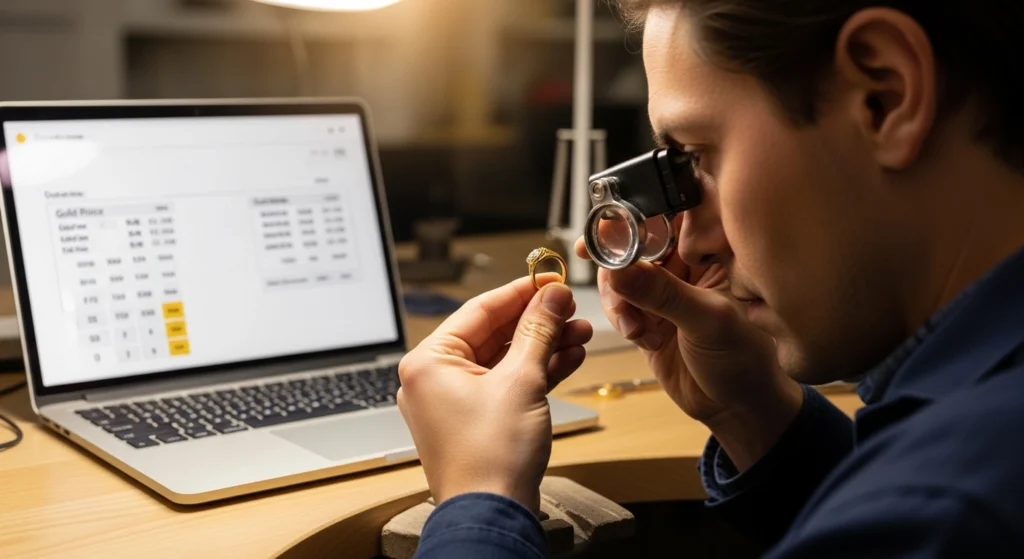
The Target Profitability slider in the gold karat calculator addresses that directly. Set the profit margin you are targeting on a retail purchase, and the calculator adjusts the suggested target purchase price to match. You see the total estimated settlement, the price per gram, the price per dwt and troy ounce, the recommended purchase price, and the estimated profit all in one view.
Beyond scrap, the calculator also helps dealers estimate how much bullion they can acquire through scrap-metal exchanges or direct purchases. If you are sourcing fine gold grain, privately minted rounds, or sovereign gold and silver products, the tool gives you a conversion reference from scrap value to bullion equivalent.
Final Thoughts
You now have everything you need to walk into any conversation about scrap gold with a real number in hand. Run the calculate scrap gold tool at the top of this page. Enter your weight. Select your karat. Let the live price do the work. Your gold has real value. Start by knowing exactly what that value is.
Frequently Asked Questions
How do I calculate how much my scrap gold is worth?
You need three things: the weight of your gold, the karat (which determines purity), and the current gold spot price. Enter your details into the scrap gold calculator above, and it runs this automatically using the live gold price.
How much is 10K gold worth as scrap?
10K gold is 41.7% pure. For every gram you have, just under half of that weight counts as gold content. Enter your weight and select 10K in the calculator to see today’s figure. Typical buyer payouts for 10K run between 65% and 85% of the melt value, depending on who you sell to.
How much is 14K gold worth as scrap?
14K is the most common karat in US jewellery at 58.3% purity. It sits in the middle of the scrap value range. The 14 karat gold scrap calculator gives you the cleanest estimate: enter your weight in grams, select 14K, and the live price does the rest.
How much is 18K gold worth as scrap?
At 75% purity, 18K gold has a noticeably higher melt value per gram than 14 K gold. A gram of 18K gold contains nearly three-quarters of its weight as pure gold. Run it through the scrap gold per gram calculator above to see the current dollar value.
What is the difference between melt value and scrap gold payout?
Melt value is the value of the gold content at the spot price. Scrap gold payout is what a buyer actually pays you after deducting their refining fees, testing costs, overhead, and margin. Melt value is always higher.
Is gold-filled jewellery worth selling as scrap gold?
Yes, but the calculation is different. Gold-filled items are not solid gold. The stamp tells you the fill ratio, such as 1/10 14K GF. Multiply that fraction by the item’s total weight to get the actual gold weight, then enter that smaller number into the calculator at the correct karat. The final melt value will be modest, but it is real money if you have a decent quantity.
Why does the calculator show more than what buyers offer?
Because the calculator shows 100% of the melt value, and no buyer pays 100%. They have to cover refining, testing, labour, shipping, and margin. A difference of 10% to 30% below the calculated melt value is completely normal and standard across the industry.
How often is the gold price updated in the calculator?
The calculator pre-fills with the current market price during active trading hours and reflects live gold spot price data. You can also type in any price manually if you want to model a different scenario.
Can I use this calculator for silver scrap, too?
This calculator focuses on gold by karat. For silver scrap, the calculation uses a different purity system based on fineness rather than karats. If you have silver pieces, weigh them separately.