Gold Karat Guide: What Each Karat Means and How to Measure It
You walked into a jewellery store, and the salesperson said “14 karat,” and you nodded along without really knowing what that meant. You’re not alone. Most people have no idea what karat numbers actually tell you, why they matter, and how they connect to what your gold is worth when you buy or sell it.
The number stamped on your gold controls everything. It decides the colour you see, how long the piece lasts, whether it irritates your skin, how much you pay for it new, and exactly what you receive when you sell it as scrap. Get this wrong, and you either overpay for a piece or walk away from a buyer having left real money on the table.
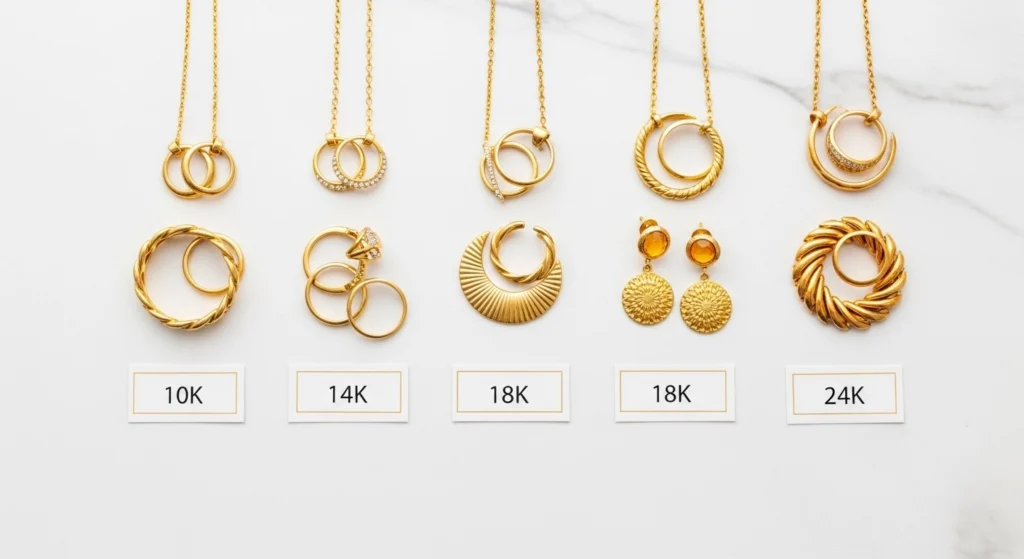
This guide covers all of it. What each karat actually means. How to read and test karat stamps at home. What 10 karat, 14 karat, 18 karat, 22 karat, and 24 karat gold look like in real life. How gold scrap prices connect back to the karat number.
Once you have successfully identified your item’s karat, head over to the scrap gold calculator to see its current worth.
What Is a Karat? The 24-Part Scale, Explained Simply
Gold purity runs on a 24-point scale. Every single karat represents one twenty-fourth of the total metal content in a piece. So 24 karat gold means all 24 parts are gold. Nothing else. 14 karat means 14 of those parts are gold, and the remaining 10 parts are other metals.
Those other metals are called alloying metals. Copper, silver, zinc, nickel, and palladium are the most common. They get mixed in because pure gold on its own is genuinely too soft for most jewellery. It bends. It scratches. It loses its shape. Alloying metals fixes that by adding hardness and structure without removing the gold content entirely.
So when someone says 14 karat gold, they mean a metal that is 58.3% pure gold and 41.7% alloying metals. When they say 18 karat, that is 75% gold. The math is simple: divide the karat number by 24, multiply by 100, and you have the purity percentage.
Karat vs. Carat: One Sentence
Karat (K) measures gold purity. Carat (ct) measures gemstone weight. Two different words. Two different jobs. You will see both in jewellery, and they mean completely separate things.
The basic formula works like this:
Karat Stamps vs. Fineness Numbers
Not every piece of gold uses the K format. Many countries and international buyers use a three-digit fineness number instead. Both systems say the exact same thing in a different format. Here is the full reference:
Karat | Fineness Stamp | Gold Purity | Color | Common Use | Scrap Value Per Gram* |
10K | 417 | 41.7% | Light yellow | Everyday jewellery, US fashion rings | Lowest per gram, high volume |
14K | 585 | 58.3% | Warm yellow | Engagement rings, chains, earrings | Mid-range, most traded |
18K | 750 | 75.0% | Deep yellow | Luxury pieces, designer jewelry | Higher per gram |
22K | 916 | 91.6% | Rich yellow | Indian, Middle Eastern jewelry | High, less common in US |
24K | 999 | 99.9% | Intense yellow | Bullion, investment, coins | Benchmark: all others are % of this |
*Scrap value per gram fluctuates daily with the gold spot price. Use our gold scrap calculator for today’s live rate.
If you are confused about which input fields correspond to your karat stamp, review how to use gold scrap calculator.
How to Measure and Identify Gold Karats
Knowing your karat before you buy, sell, or use a gold scrap calculator is the single most important step. Here are all the methods people actually use, from free home checks to professional lab-level testing.
Step One: Find the Hallmark Stamp
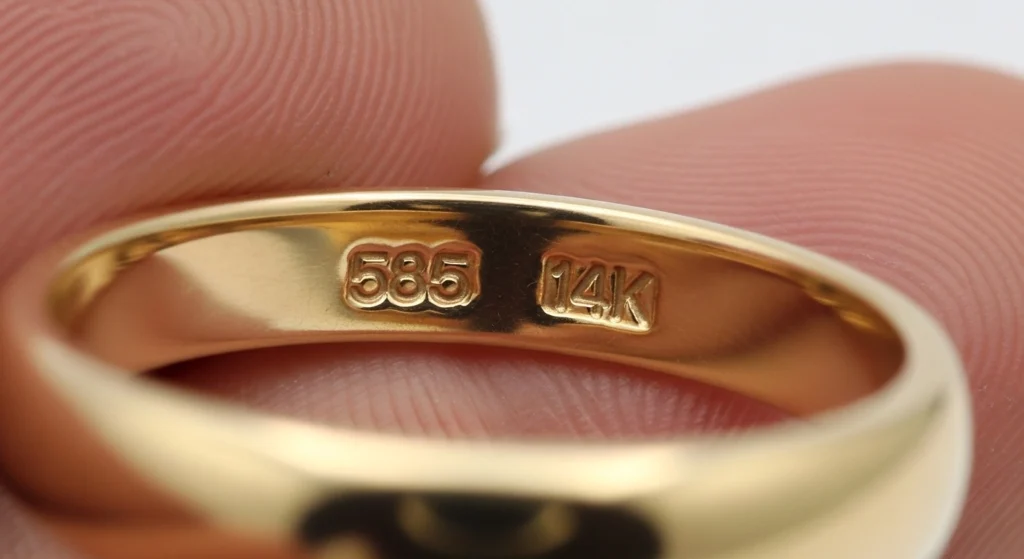
The hallmark stamp is the fastest and most reliable method. In the United States, any piece of solid gold sold commercially is required to carry a karat marking. Here is where to look:
- Rings: on the inside of the band
- Necklaces and bracelets: near or on the clasp
- Earrings: on the post or back of the stud
- Pendants: on the bail, the small loop that connects to the chain
A clean stamp reads 10K, 14K, 18K, 585, 750, or one of the fineness numbers from the table above. These are unambiguous. No calculation needed.
Watch out for these stamps, because they do not mean solid gold:
- GP = gold plated. Microscopically thin gold layer over base metal
- GF = gold filled. A thicker gold layer bonded to base metal, but still not solid gold
- GEP, HGE, RGP = various electroplating methods, all non-solid
- Vermeil = gold plating over sterling silver, not karat gold
Gold-filled scrap is a separate category entirely. It carries some value, but a fraction of what solid karat gold fetches, and most standard buyers will not accept it. Specialised bulk refiners handle gold-filled scrap, usually only when you have significant volume to sell. If you have a gold-plated piece and are wondering how to measure its value, read our gold-plated scrap guide.
The Magnet Test
Real gold is not magnetic. Hold a strong rare-earth magnet close to the piece. A strong pull means it is almost certainly not solid gold. This test is a fast filter, not a confirmation. Many base metals are also non-magnetic, so passing the test does not guarantee the piece is genuine. But failing it tells you something useful immediately.
One note: some clasps and pin backs on otherwise genuine pieces contain a small spring made from magnetic metal. Do not panic if only the clasp pulls slightly. Test the main body of the piece.
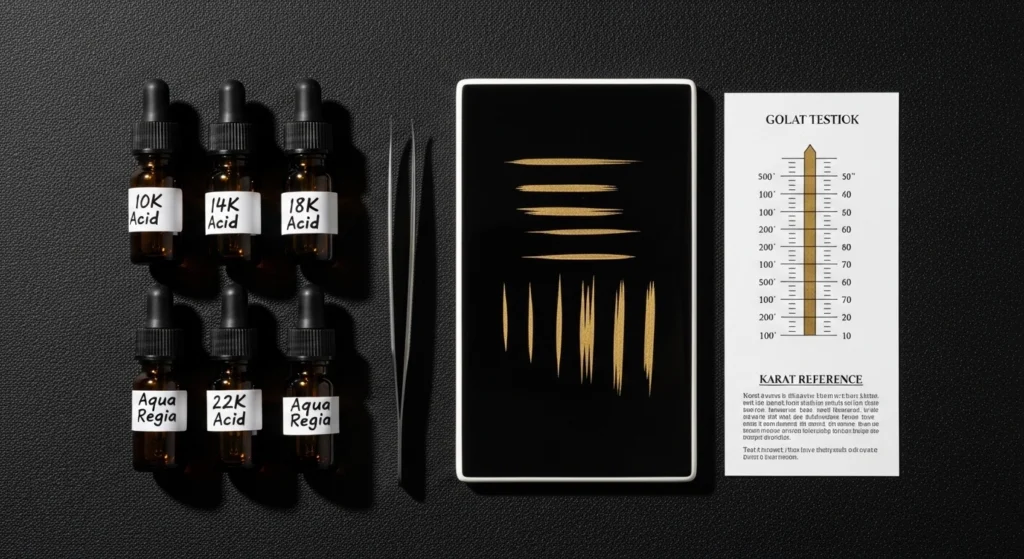
Acid Testing
This is the method used by pawn shops, jewellers, and most professional gold buyers. A small scratch is made on a ceramic testing stone, and acid solutions of different strengths are applied to the mark. Each acid reacts differently depending on purity. An acid rated for 10K will not dissolve 18K gold, but will dissolve base metal. An 18K acid solution will dissolve a 10K piece. The reaction pattern identifies the karat range with strong reliability.
Home acid testing kits are inexpensive and widely available. They are not as precise as lab testing, but they give you a solid working estimate before you talk to any buyer.
Electronic Testing and XRF Analysis
Electronic gold testers pass a small electrical current through the metal and estimate purity based on how it conducts. They are fast, non-destructive, and common in professional settings. Not as accurate as acid testing for older or plated pieces, but useful for a quick check.
XRF analysis, or X-ray fluorescence, is the most accurate non-destructive method available. The machine fires X-rays at the metal and reads back an exact elemental breakdown. It tells you the precise gold percentage plus what alloy metals are present. This is what high-volume buyers and refiners use. You will not find it at home, but reputable gold buyers often have one on site.
Fire Assay: The Most Accurate Method
Fire assay is the gold industry’s final word on purity. The piece is melted and chemically analysed. The result is exact. There is no ambiguity.
The drawback is that it is irreversible. You are not getting the original piece back. Refineries use this for final settlement calculations on bulk lots.
For most sellers, the practical approach is this: find the stamp, run a magnet test, and then ask any reputable buyer to acid test or electronically test your piece before you commit to anything. Most jewellers and professional gold buyers will do this at no cost.
Higher karats approach the actual spot price of the metal; see our comparison of gold scrap vs bullion value to understand the margins.
Karat and Scrap Value: How the Numbers Connect
Every karat corresponds to a fixed gold percentage. That percentage determines exactly how much a piece is worth at any given spot price. The formula is the same regardless of what you are selling:
Melt value = Weight (grams) x Karat purity % x Spot price per gram
Spot price per gram is simply the current spot price per troy ounce divided by 31.1, because one troy ounce equals 31.1 grams. This is a common mistake. Regular ounces and troy ounces are not the same. Gold is always priced in troy ounces. Using the wrong unit gives you a calculation error of nearly 10%.
The melt value from this formula is the theoretical maximum. It is what the piece would be worth if you could extract every gram of pure gold instantly with zero cost. That is not how the real world works. What a buyer actually pays is a percentage of that melt value, after deducting their refining costs, processing, and margin.
Why Scrap Payout Is Always Below Spot
Pawn shops typically pay between 50% and 70% of the melt value. Local jewellers and dedicated gold buyers sit at around 65% to 80%. Online gold buyers run higher, usually 80% to 92%, because their operating costs are lower. Refineries pay the most, between 85% and 95% of melt value, but they work in bulk and typically have minimum quantity requirements.
Any offer that comes in below 70% of the melt value you have already calculated deserves a counter. Get at least two or three quotes before you commit to anything. Payouts between different buyer types can differ by 30% or more on the same piece.
Buyer Type | Typical Payout | Pros | Cons |
Pawn shop | 50–70% of melt | Instant cash on hand | Lowest offers in the market |
Local jeweller or gold buyer | 65–80% of melt | Face-to-face, testable | Varies widely by location |
Online gold buyer | 80–92% of melt | High payouts, insured shipping | Shipping risk, wait time for payment |
Refinery (bulk lots) | 85–95% of melt | Best rates for large quantities | Minimum quantities usually required |
Medical grade metals often have unique, non-standard karat stamps; learn how to identify your dental gold scrap.
How Karat Affects Gold Colour, Not Just Purity
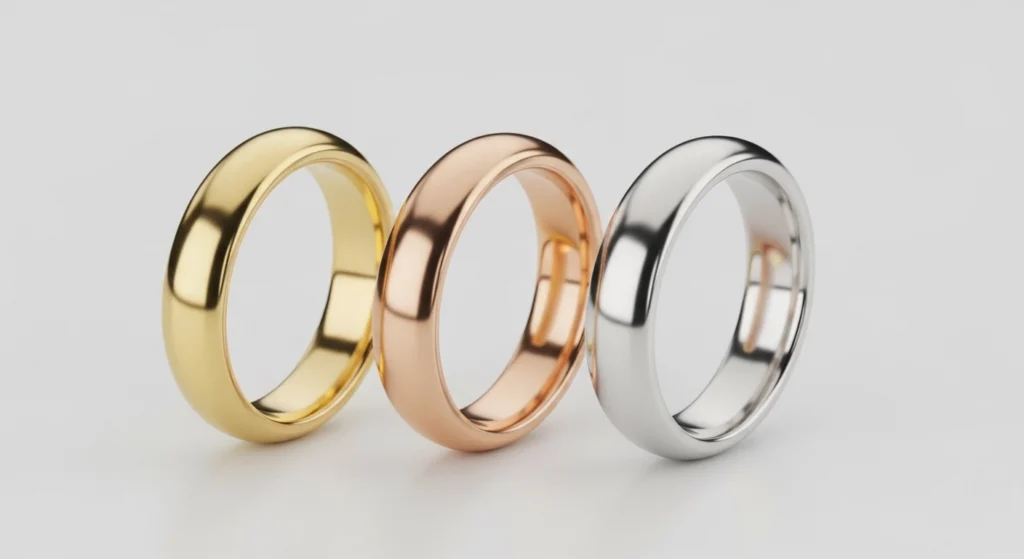
The alloying metals mixed into gold do more than add strength. They change the color. This is how yellow gold, white gold, and rose gold are all made from the same base metal at the same karat level.
Yellow gold
It uses gold combined with copper and silver. The classic warm tone. The higher the karat, the more visible that gold warmth becomes. 24K is almost orange-yellow. 10K is noticeably pale.
White gold
It is made by mixing gold with nickel, palladium, or platinum. The surface is almost always coated with rhodium, which gives it that bright, silver-white finish. That rhodium coating wears through with time. The metal underneath is off-white or slightly warm. White gold and platinum are not the same material. Next to a platinum ring, white gold at 14K will look visibly warmer.
Rose gold
It comes from mixing gold with a higher proportion of copper. More copper means a pinker tone. It is available in both 14K and 18K. The 14K version tends to have a slightly deeper blush because of the higher copper ratio in the alloy.
Here is something that catches a lot of people off guard: a 14K yellow gold ring and a 14K rose gold ring have exactly the same gold content and exactly the same scrap value per gram. The colour difference is purely a function of which alloying metals were used. When you use a gold scrap calculator, colour does not change the output. Only the karat and the weight matter.
Be careful not to confuse a solid karat stamp with hallmarks that indicate a much lower gold platted scrap value.
How to Use Our Gold Scrap Calculator
Run your calculation before you talk to any buyer. Here is the process:
- Find the karat stamp on each piece and sort everything by karat
- Weigh each karat group separately using a digital jewellery scale accurate to 0.01g
- If stones are set, subtract stone weight or ask your buyer to remove them before weighing
- Open the gold scrap calculator and enter your weight and karat
- The tool pulls today’s live spot price and shows your melt value instantly
- Compare that number against the payout percentages above to set your baseline before negotiating
Do not mix karat groups on the scale. Do not include clasps, settings, or non-gold components if you can separate them. Some clasps on chains are a lower karat than the chain itself. Always confirm. If you want a detailed guide on how to use the gold scrap calculator, visit our page.
The calculator gives you your melt value. Anything below 70% of that number is a weak offer. Anything at 85% or above from a reputable buyer is a strong one.
Choosing the Right Karat When Buying Gold
No single karat is universally the best. The right choice depends entirely on how the piece will be worn, how long it needs to last, and what trade-offs you are comfortable with.
Your Priority | Best Karat | Why |
Daily wear, active lifestyle | 10K or 14K | High alloy content resists scratching and bending |
Engagement ring or wedding band | 14K (durability) or 18K (richness) | 14K lasts through daily wear; 18K offers deeper colour |
Sensitive skin | 18K nickel-free | Less alloy means fewer reactive metals against the skin |
Luxury or special occasion piece | 18K | 75% gold gives a noticeably richer, warmer tone |
Investment or ceremonial use | 22K or 24K | Highest gold content, closest to pure gold value |
One thing worth knowing: the scrap value of 14 karat gold and 18 karat gold both hold up well over time because both karats trade heavily in the market. You are not locked into a low-demand niche if you ever need to sell either karat. 10K is slightly less liquid in the high-end buyer market, but still finds buyers readily because of its volume in domestic circulation.
Frequently Asked Questions
Is 14K or 18K gold better for everyday wear?
14K is the stronger choice for daily wear. The higher alloy content makes it more resistant to scratching, denting, and structural stress from regular contact. 18K looks richer and carries more gold, but it shows surface wear faster under the same conditions.
How do I know if my gold is real and not plated?
Start with the hallmark stamp. Run a magnet test as a second step. For confirmation, take it to a jeweller or professional gold buyer. Most will test it for free using an acid or an electronic tester before they commit to any transaction.
How much is 10 karat scrap gold worth?
It depends on weight and today’s gold spot price. The formula is: weight in grams multiplied by 0.417 multiplied by the current spot price per gram. Use the gold scrap calculator on this site for a live number.
What is the scrap value of 14 karat gold right now?
Melt value for 14 karat gold = weight in grams x 0.583 x current spot price per gram. Our 14 karat gold scrap calculator pulls live data and gives you today’s number instantly.
Does the condition of gold jewellery affect its scrap price?
No. Condition has no effect on melt value. A bent 14 karat gold chain weighs the same as a perfect one of identical length. Do not let a buyer discount your offer because a piece is broken, tarnished, or old.
What is the difference between karat gold and gold-filled?
Karat gold, whether 10K, 14K, or 18K, is the same alloy all the way through. Gold-filled has a thin gold layer mechanically bonded to a base metal core, typically making up only 5% of the total weight. They look similar, but their scrap value is not comparable.
Why do gold scrap prices change every day?
Because the gold spot price changes every day based on global commodity markets, currency movements, inflation data, central bank activity, and supply and demand shifts. Scrap gold prices move with the spot price because scrap value is a direct percentage of it.