How to Use the Gold Scrap Value Calculator? Step-by-Step Guide
You have a drawer full of old jewellery. Maybe a broken bracelet, a ring from a past relationship, or a gold tooth crown a dentist removed three years ago. You know it’s gold. You know gold prices are high right now. But you have no idea what any of it is actually worth, and every time you walk into a pawn shop or jewellery store, you feel like you’re getting lowballed without knowing it.
That is exactly why people search for a scrap gold calculator. Not to become gold experts. Just to know their number before they talk to anyone.
This guide walks you through every step of using our online gold scrap calculator, from sorting your items to reading the final net payable figure. By the end, you will know how to calculate scrap gold value on your own and walk into any sale with confidence.
Even items that aren’t solid alloy can be evaluated using the settings on our main scrap gold calculator.
What You Need Before You Start
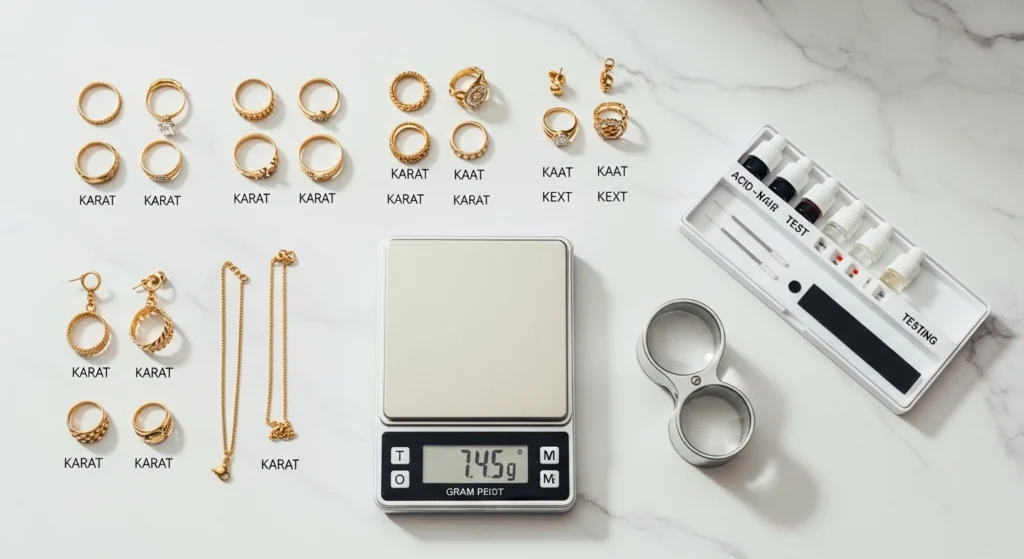
Getting the calculator output right comes down to two things: knowing the karat of each item and having the correct weight in grams. If either one is wrong, the result is wrong. Simple as that.
A lot of people skip this preparation step and then wonder why the dealer’s offer looks nothing like their calculator number. Usually, it’s because they weighed a ring with the stone still in, or they guessed the karat instead of checking the stamp.
Take ten minutes here. It saves a lot of confusion later.
Scrap gold value comes down to two things.
How to Find the Karat of Your Gold
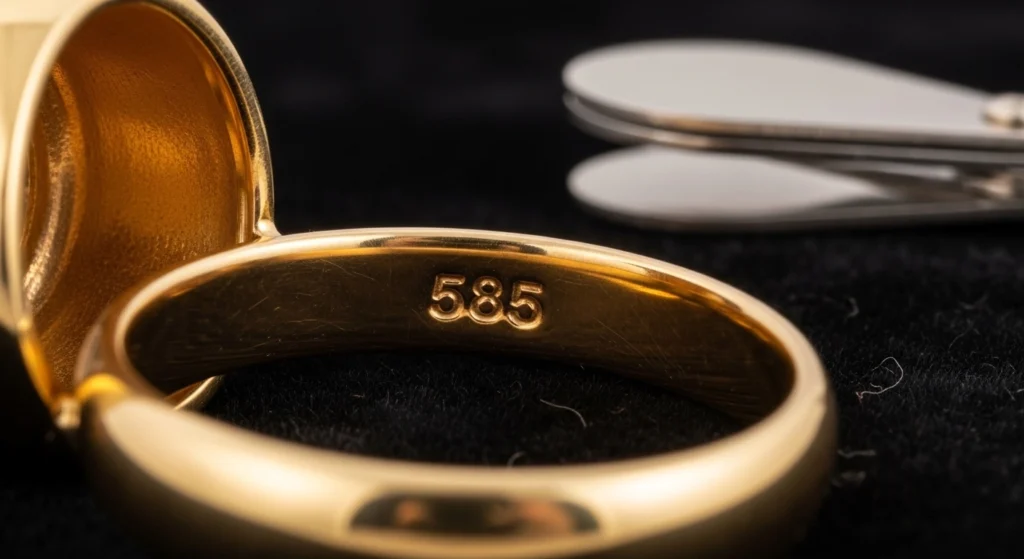
The karat stamp is almost always there. You just have to know where to look. On rings, check the inside of the band. On necklaces and bracelets, check the clasp. On earrings, check the post or the back finding.
The stamp will either show the karat directly (like 14K or 18K) or use a three-digit number called a millesimal fineness mark. Here is what those numbers mean:
Stamp | Karat | Gold Purity |
999 | 24K | 99.9% pure gold |
916 | 22K | 91.7% pure gold |
875 | 21K | 87.5% pure gold |
750 | 18K | 75.0% pure gold |
585 | 14K | 58.3% pure gold |
417 | 10K | 41.7% pure gold |
GF / 1/20 14K | Gold-Filled | ~5% gold by total weight |
No stamp? Use an acid test kit. They cost around $10 to $15 and give you a fast, clear answer. A small scratch on a testing stone, a drop of acid, and the reaction tells you the purity level. For items where you genuinely cannot determine the karat, a refiner can run an XRF analysis and give you a precise reading. If you want a detailed guide, you can visit our gold scrap karat guide to learn how to measure it accurately without guessing.
Never enter a guessed karat into the gold scrap calculator. The difference between 14K and 18K purity alone changes your calculated value by nearly 29%. That is not a rounding error. That is a real money difference.
It is incredibly important not to confuse gold-filled items with those that have a microscopically thin gold platted scrap value.
How to Weigh Your Gold Correctly
Use a digital scale that reads to 0.01 grams. At today’s gold scrap prices, one gram of 18K gold is worth around $70 or more, depending on the spot price. A cheap kitchen scale that rounds to the nearest gram is not good enough for this.
Before you put anything on the scale:
- Remove all gemstones if possible. Diamonds, rubies, and other stones add weight with zero gold value.
- Take off any steel or silver clasps that are clearly a different metal.
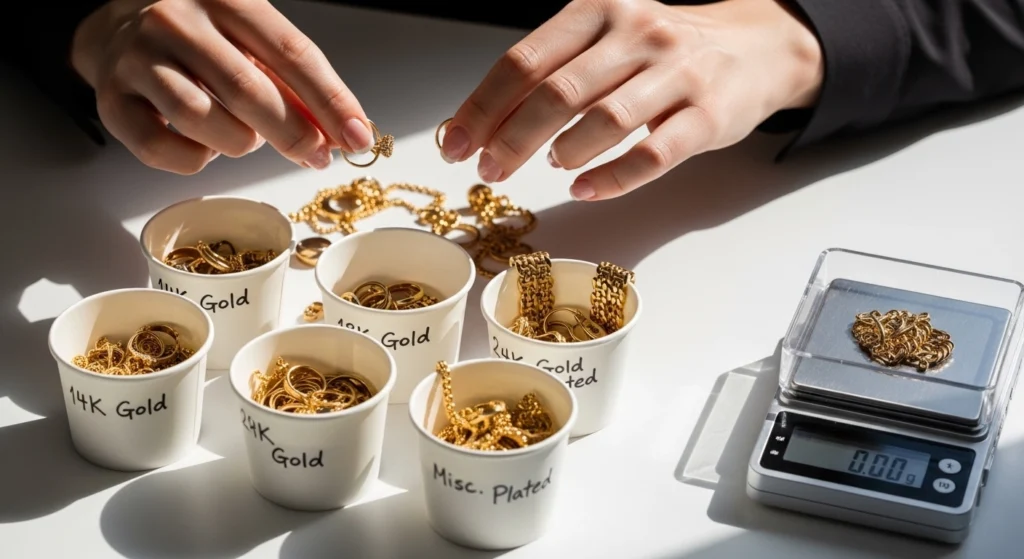
- Weigh each karat group separately. A mixed pile on the scale gives you one useless number.
- Make sure your scale is set to grams, not ounces or pennyweights.
Write down the weight of each karat group before you open the calculator. Something like “14K: 8.4g, 18K: 3.1g” takes thirty seconds and removes all confusion when you are filling in the fields.
Entering filled items into our system requires specific steps; see how to use gold scrap calculator for detailed instructions.
How to Use the Gold Scrap Calculator: Step by Step

Step 1: Enter Your Gold Weight by Karat
- Find the karat row that matches your gold (24K, 22K, 21K, 18K, 14K, or 10K)
- Type your gram weight into that row’s input field
- Repeat for each karat group you have
- Leave all other rows at zero
- Do not add different karats together into one row
The calculator shows the estimated USD value for each row the moment you enter a weight. You can see your 14K total and your 18K total separately, which matters if you’re considering selling to different buyers.
Step 2: Check the Live Gold Price
- The spot price field auto-fills from the live market
- Glance at it before proceeding
- If you want to model a different price (say, you’re planning to sell next month), type your target price into the field manually
- The calculator recalculates every row instantly when you change this number
This manual override feature is genuinely useful. If you think gold prices will rise before you sell, you can see what your lot would be worth at $3,200/oz versus $3,500/oz and decide whether waiting makes financial sense.
Step 3: Read the Per-Karat Value Rows
Each row now shows you the gross melt value for that karat group. At this point, the online gold scrap calculator has done its primary job. You can see the breakdown clearly and verify that the numbers look right relative to how much gold you have.
If something looks off, go back and double-check your weight entry for that row. A value that seems too high usually means a decimal point is misplaced somewhere.
Step 4: Read Your Net Payable Amount
The bottom of the calculator shows two figures. The total gross value is your ceiling: what 100% of spot looks like for your specific lot. The net payable is your realistic working number after the refining deduction.
The gap between these two figures is what you negotiate. If your gross value is $620 and a buyer offers $390, they are paying you 63% of the melt value. You now know to ask whether they can do better, or to take the lot to a refiner who charges a smaller percentage.
Step 5: Enter the Refining Fee Percentage
This is the field that closes the gap between calculator output and real-world payout. Every buyer, refiner, and dealer deducts a percentage from the melt value before paying you. That deduction covers the actual cost of refining, their overhead, and their margin.
Enter the percentage in the refining fee field. Here is what typical deductions look like by buyer type:
Buyer Type | Typical Deduction from Melt Value | What You Actually Receive |
Direct Refiner | 3–15% | 85–97% of melt value |
Online Gold Buyer | 10–25% | 75–90% of melt value |
Coin or Jewellery Dealer | 20–30% | 70–80% of melt value |
Pawn Shop | 30–50% | 50–70% of melt value |
If a buyer told you they pay “75% of spot,” enter 25 in the refining fee field. The live scrap gold calculator will show you your net payable at that rate. Then try entering a different buyer’s percentage and compare the two net payable figures side by side. This takes about 90 seconds and tells you clearly who is giving you the better deal.
How the Calculator Actually Does the Math
You don’t need to run this formula manually because the tool does it for you. But understanding it helps you trust the output and spot any errors.
The formula the calculator uses for each karat row is:
Melt Value = Weight in grams × (Karat ÷ 24) × Current spot price per gram
Real example. You have a 14K bracelet that weighs 8.4 grams. Gold is currently trading at $97 per gram.
Purity factor: 14 ÷ 24 = 0.583
Pure gold content: 8.4 × 0.583 = 4.9 grams of actual gold
Melt value: 4.9 × $97 = $475.30
That $475.30 is the gross melt value. It is what your bracelet is worth at 100% of the spot price before any costs come out. The scrap gold price calculator runs this same calculation for every karat row you fill in, then adds them together and shows you the combined total.
Then it applies your refining fee and shows you the net payable. That net payable is the realistic number, not the gross figure.
What "Melt Value" Actually Means and Why It's Not What You Get Paid
Melt value is the pure gold content value of your item at 100% of the current spot price. It is a theoretical number. It assumes your gold is already refined, standardised, and sitting in a vault. It is not the amount a buyer will hand you.
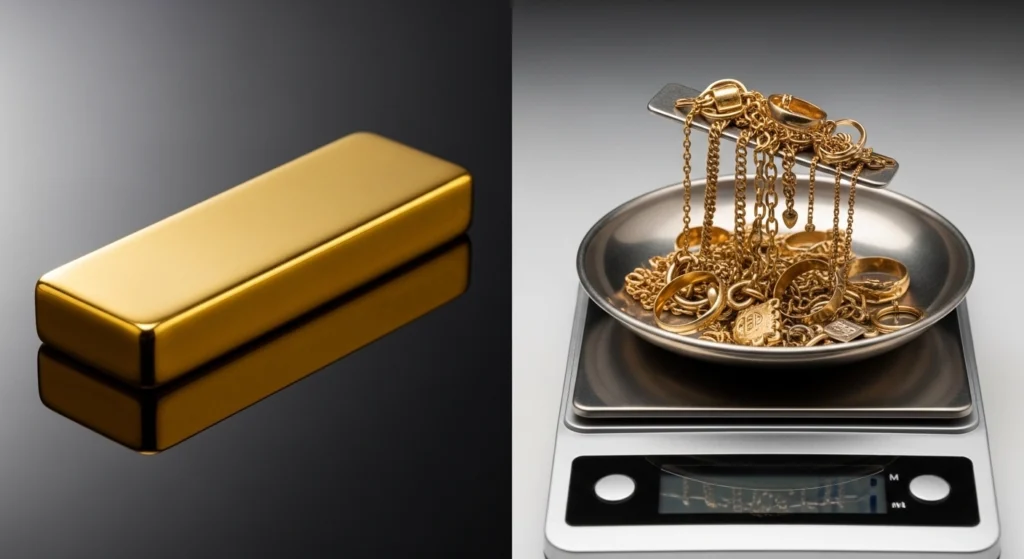
This is the number that the gold scrap vs bullion value confusion almost always comes from. Bullion, like gold bars or sovereign coins, trades at or very near spot price because it is already refined. Scrap gold still needs to be processed. The refiner has to melt it, test it, extract the pure gold, separate out the copper and silver alloy metals, and account for any processing losses along the way.
All of that has a real cost. So the difference between the melt value and your actual payout is not a dealer ripping you off. It is a real production cost. The question is whether the specific percentage a buyer is charging is reasonable or excessive. The calculator helps you answer that question before you walk in the door.
How to Calculate Gold-Filled Scrap Value
Gold-filled items are not solid gold and do not go into the standard karat rows. Most people don’t realise this and enter their gold-filled pieces the same way as solid jewellery, which produces a wildly inflated result.
Gold-filled jewellery has a solid layer of gold bonded to a brass base metal under heat and pressure. The most common type is stamped 14K/20 or 1/20 14K, meaning the gold layer makes up 1/20th of the total weight, which is 5% of the item by weight.
Here is how to calculate it manually and then enter it into the tool:
Take the total weight of your gold-filled pieces. Multiply by 0.05. That gives you the 14K gold content in grams. Enter that figure into the 14K row of the gold-filled scrap calculator.
Example: 60 grams of 14K/20 gold-filled scrap.
- Gold content: 60 × 0.05 = 3 grams of 14K gold
- Enter 3 grams in the 14K row
- The calculator applies the 14K purity factor and shows the melt value of the gold layer only
The payout on gold-filled scrap is considerably lower than that of solid gold scrap by volume because most of what you’re weighing is brass. But the gold content is real and worth calculating accurately.
Items stamped GP (gold plated), GE (gold electroplate), or HGE (heavy gold electroplate) are a different category entirely. The gold layer is so thin that most refiners won’t process it. Do not enter gold-plated items into the calculator.
Common Input Mistakes and How to Avoid Them
Most wrong calculator outputs trace back to one of these five errors.
- Mixing karat groups on the scale. Weighing all the gold together and entering it under one karat row overstates or understates the value every time. If you have 14K and 18K together and enter them all as 18K, you inflate your result by 29%. Sort first.
- Including non-gold weight. Gemstones, steel clasps, and decorative inserts all add grams to the scale that contain no gold value. A thick gemstone setting can add 2 to 3 grams to a ring that would otherwise weigh 4 grams. That doubles the entered weight and doubles the error.
- Wrong weight unit. If your scale reads pennyweights or troy ounces and you enter that number into a grams field, your output is off by a factor of 1.555 or 31.1. Confirm your unit every time before entering.
- Leaving the refining fee at zero. The gross melt value looks encouraging. But entering zero in the fee field gives you a number that no buyer will ever pay. Always enter a realistic deduction based on the type of buyer you’re selling to.
- Not checking the live price. The online scrap gold calculator pulls a current spot price, but connection delays happen. For any lot worth over $500, cross-reference the displayed price before you finalise your estimate.
Understanding Gold Karat and Why It Changes Everything
Here is a thing most people don’t fully grasp until they see the numbers. The karat of your gold doesn’t just slightly affect the value. It changes it dramatically.
Two rings, same weight at 10 grams each. One is 10K, and one is 18K. The gold scrap karat difference means the 10K ring contains only 4.17 grams of pure gold. The 18K ring contains 7.5 grams of pure gold. Same physical weight on the scale. Nearly double the actual gold content. That gap is why sorting by karat before weighing is non-negotiable.
The scrap gold price calculator on this page accounts for this automatically once you enter each weight into the correct karat row. But you have to give it the right input first.
Frequently Asked Questions
How do I calculate the value of scrap gold at home?
Weigh your gold in grams by karat group, then use this formula: Weight × (Karat ÷ 24) × current gold spot price per gram. The result is your gross melt value. Subtract your expected refining fee percentage to get a realistic net estimate. The calculator on this page runs the full calculation automatically once you enter your weights.
What is 14 karat gold worth as scrap right now?
14K gold contains 58.3% pure gold. To get the current per-gram scrap value, multiply the live 24K spot price per gram by 0.583. Enter your 14K weight into the 14 karat gold scrap calculator on this page to get an up-to-date figure based on the live spot price.
Why is the calculator number different from what a dealer offered me?
The calculator shows gross melt value at 100% of spot price. No buyer pays 100% of spot price because refining has a real cost. The dealer’s offer represents their deduction percentage applied to your melt value.
Can I use this for gold coins?
Yes, but with a note. If a coin has numismatic or collector value, its worth often exceeds the melt value. Use the gold scrap calculator to find the metal content value.
How do I calculate gold-filled scrap separately?
Multiply the total weight of your gold-filled items by 0.05 to get the 14K gold content in grams, then enter that figure in the 14K row. Do not enter the full weight of a gold-filled item into a standard karat row.
Does the live scrap gold calculator update in real time?
Yes. The spot price updates continuously from the live market. For large lots, verify the displayed price independently before finalizing your estimate to account for any brief data delays.
Is the scrap gold calculator USA price shown in USD?
Yes. The calculator uses USD based on the New York spot price. If you are selling in a different country, the net payable figure will need to be converted at the current exchange rate. Regional taxes and local buyer fees may also apply on top of the displayed USD value.
What items should I not enter into the calculator?
Gold-plated items (stamped GP, GE, HGE, or RGP) should not be entered as solid gold. Gold-filled items need a separate calculation as described above. If you’re unsure whether an item is solid gold or plated, an acid test will confirm it before you calculate.