What Is Your Removed Gold Crown Worth? Calculate It Right Now
That crown your dentist just handed you is not trash. It is not a keepsake either. It is scrap dental gold, and depending on its weight and karat, it could be worth anywhere from $50 to well over $200.
The problem most people run into is not finding a buyer. It is showing up to sell without knowing what they have. Buyers count on that. When you walk in without a number in your head, you accept whatever offer lands on the table.
Do not do that.
Use the gold scrap calculator right now. Enter your crown’s estimated weight and karat, and get a real-time payout estimate based on today’s gold spot price. Then read the rest of this page to understand exactly what that number means and how to protect it when you sell.
What Karat Is Your Dental Crown? Here Is How to Find Out
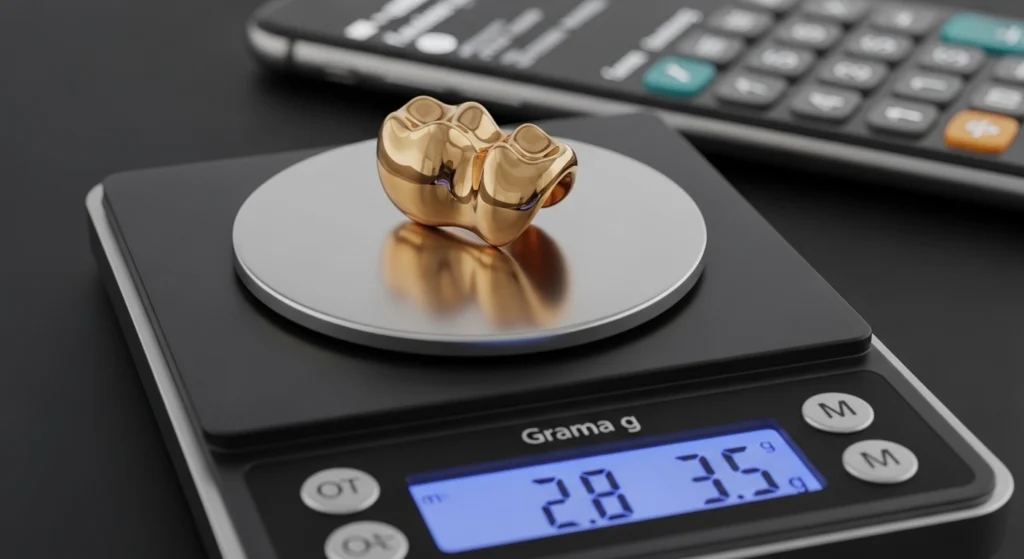
This is the part that trips most people up, because dental gold is not stamped or labelled the way jewellery is. There is no “14K” engraved anywhere on a dental crown. The karat was decided by the dental lab that made it, and that information rarely follows the crown out of the dentist’s office.
Here is what the ranges look like and what they mean for your dental gold scrap price:
- 10 to 14 karat covers most crowns placed in the last 20 years. Gold content ranges from 40% to 58% of the total weight. This is the most common range you will encounter.
- 16- to 18-karat gold is more common in older restorations, particularly crowns placed 20 or more years ago. Gold content between 67% and 75%. These pay out noticeably better per gram.
- 20 to 22 karat is less common but exists, particularly in older European dental work and some speciality restorations. Gold content up to 92%. These are the highest value pieces.
Refer to the gold karat guide if you want a full table of karat to percentage conversions before you run your calculator estimate.
The Only Reliable Way to Confirm Karat
You cannot test dental gold karat accurately at home. Acid test kits are unreliable on alloys. Visual inspection tells you nothing precise.
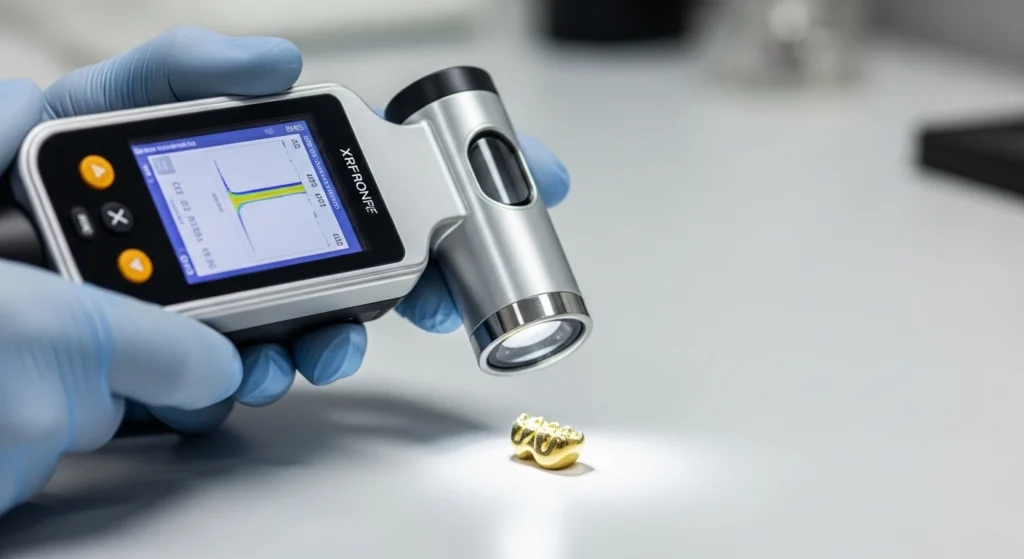
The correct method is XRF analysis, which stands for X-ray fluorescence. A reputable buyer scans your crown with XRF equipment and gets a precise readout of every metal present and its exact percentage. The process takes seconds. You see the numbers. You know exactly what you have.
If you aren’t sure how to properly weigh and enter these unique medical items, read how to use gold scrap calculator.
What Actually Determines Your Scrap Dental Gold Value
Three numbers drive your payout. Nothing else matters as much as these.
Weight in grams
Most gold crowns weigh between 2 and 4.5 grams. A bridge covering multiple teeth will weigh more. Heavier means more total metal content, which means a higher base value before any other factor is applied.
Karat of the gold alloy
Dental gold is never pure gold. It is always mixed with other metals like palladium, silver, and copper to make it hard enough to survive years of chewing. The karat tells you what percentage of the total weight is actual gold. A 16 karat crown is 67% gold. A 10 karat crown is only 40% gold. Same weight, very different value.
Today's gold spot price
Gold trades on international markets every day, and the price moves constantly. Your payout is tied directly to the spot price on the day your crown is assessed. This is why checking today’s number matters, not a figure you read last month.
The gold scrap calculator pulls live spot price data and applies it to your weight and karat inputs automatically. You get a current estimate, not a stale one.
Is Your Crown Actually Gold?
Before you calculate anything, confirm what you have. Not every removed crown contains precious metal, and the type of crown determines whether it has any resale value.
Here is a fast reference:
Crown Type | Contains Precious Metal? | Worth Calculating? |
Full gold alloy crown | Yes, gold and often palladium | Absolutely |
Porcelain-fused-to-metal (PFM) | Sometimes, test before discarding | Yes, get it tested |
All-ceramic or porcelain only | No precious metals | No scrap value |
Stainless steel | No precious metals | No scrap value |
Gold-filled restoration | Yes, bonded gold layer | Yes, lower payout |
Gold-plated restoration | Trace amounts only | Rarely worth selling |
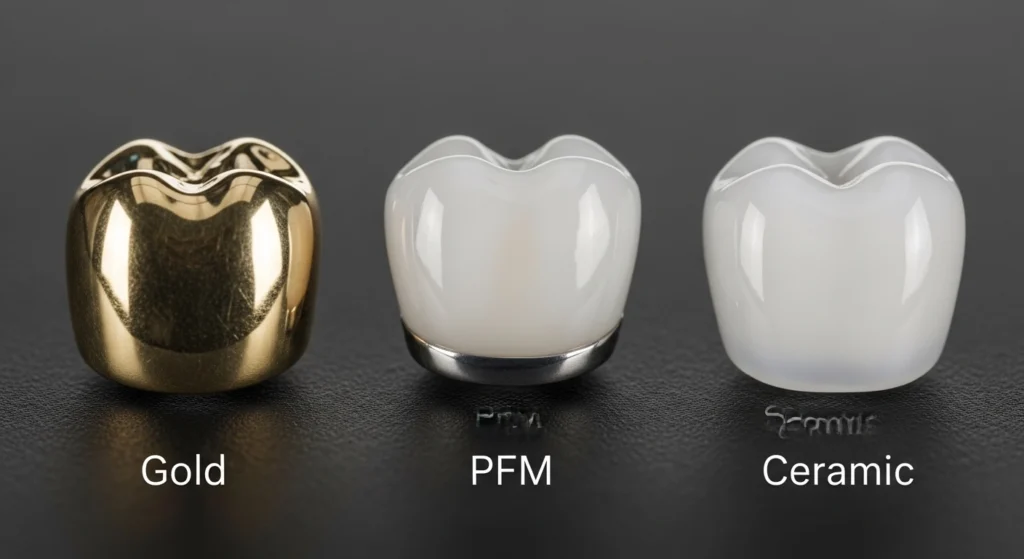
A full gold alloy crown is the highest value piece you can have. It looks yellow or slightly greenish-gold, feels heavier than it looks, and was almost certainly placed on a back molar.
A PFM crown has a white porcelain exterior. Look at the margin, the edge closest to where the gum meets the tooth. If you see a thin band of dark or metallic material there, that is the metal substructure. Some PFM crowns contain enough palladium to make selling worthwhile. Have it tested before you toss it. Testing costs you nothing with a reputable buyer.
All-ceramic or pure porcelain crowns are completely white throughout with no metal visible anywhere. These contain nothing recoverable. Move on.
If you have a gold alloy crown or a PFM, open the gold scrap calculator and start with what you have. Dental pieces are solid alloy throughout, making them far more valuable to buyers than jewelry with merely a gold filled scrap value.
How to Sell Your Scrap Dental Gold Without Getting Underpaid
Knowing your value is only useful if you can protect it during the sale. Here is how to do that.
Start with the calculator.
Run your estimate in the gold scrap calculator before any buyer conversation. This gives you a benchmark.
Use a specialist dental scrap buyer
General gold buyers and pawnshops are not set up for dental alloys. A specialist buyer has processed thousands of crowns, knows the alloy averages, and can offer better payouts because their refining operation is built around dental scrap specifically.
Ask for the breakdown
Any legitimate buyer should give you the XRF result, the spot price used, and the deduction percentage. If they hand you a number without showing the calculation, ask for it before you accept.
Sell in volume when possible
If you have multiple crowns, bridges, or other gold dental pieces, selling them together often improves your payout rate. Buyers can process bulk lots more efficiently.
Quick Checklist Before You Sell
- Estimate your value using the gold scrap calculator
- Confirm your crown type using the identification table above
- Ask your dentist if the alloy composition was ever recorded
- Choose a buyer with XRF testing capability and verified reviews
- Request an itemised payout breakdown, not just a final offer number
- Compare at least two offers if the total value is significant
Gold Scrap vs Bullion: Why Your Payout Is Below Spot Price
Knowing this one thing prevents frustration when you see your offer.
Gold bullion, meaning bars and coins, is already refined to 99.9% purity. When someone buys bullion, it is ready to trade or use immediately. Very little processing is needed.
Your dental gold scrap is an alloy. It contains gold mixed with palladium, silver, copper, and sometimes other metals. Before a refiner can sell that gold on the open market, they need to melt the entire piece down, chemically isolate each metal, and bring the gold up to market purity. That process costs real money, and those costs are passed back to you as a deduction from the spot price.
What separates a fair buyer from an unfair one is not whether they charge refining costs. It is how much they charge and whether they show you the math. A good buyer shows you the XRF result, states the spot price they used, and shows you the exact deduction percentage. You should be able to verify every number independently using the gold scrap calculator.
If a buyer gives you a final number with no breakdown, ask for the calculation. If they cannot or will not provide it, walk away.
The gold scrap vs bullion value guide breaks this down further with examples at different gold price levels if you want to dig deeper.
Gold Filled and Gold Plated Pieces: Quick Value Check
If you have other dental restorations beyond crowns, here is the fast read on each:
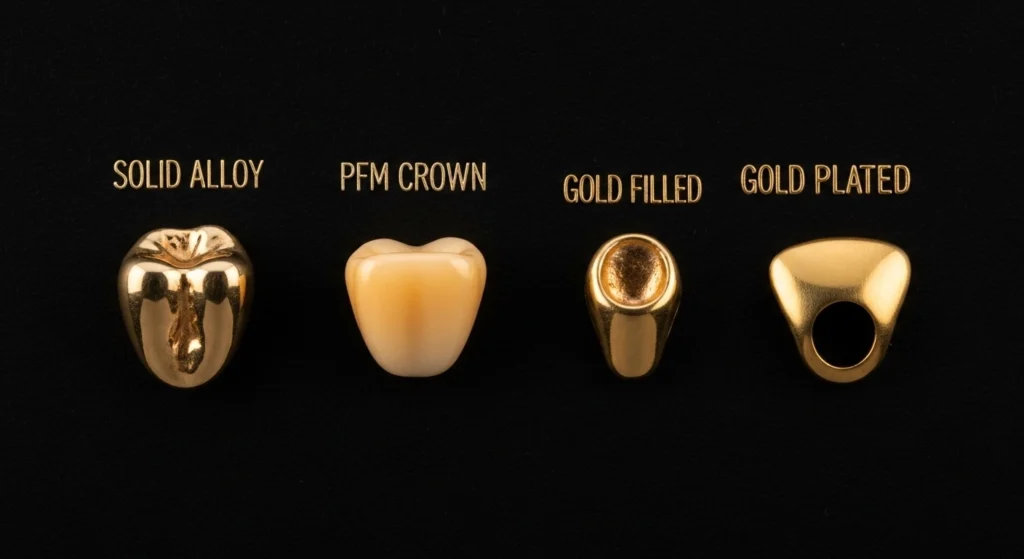
Gold-filled restorations have a bonded gold alloy layer over a base metal core. The gold layer is substantial enough to contain recoverable precious metal. Payout per gram is lower than that of solid alloy gold, but gold-filled scrap is worth selling, especially in volume. See the gold-filled scrap guide for current payout ranges.
Gold-plated restorations have only a microscopic electroplated gold surface. The actual gold content per piece is negligible. Most buyers will not purchase individual gold-plated pieces. If you have a large collection of them, the gold-plated scrap guide explains the threshold at which volume makes it worth pursuing.
When in doubt, bring everything to your buyer. XRF testing is fast and costs you nothing. Let the scan decide what is worth selling.
What About PFM Crowns? Do Not Throw Them Away Yet
If you have a porcelain-fused-to-metal crown along with your gold alloy crown, hold onto it until it gets tested.
PFM crowns have a porcelain surface and a metal base underneath. That metal base varies widely by manufacturer and era. Some PFM bases are nickel or chromium alloys with no precious metal value. Others, particularly older ones, use alloys with meaningful palladium content.
Palladium is a platinum group metal. Its price per gram has historically rivalled gold and exceeded it during certain market periods. A PFM crown with a palladium-heavy base can yield a genuinely useful payout.
The XRF scan that tests your gold crown will test your PFM crown in the same session. It costs nothing extra and takes seconds. There is no reason to discard a PFM crown without knowing what is in it first.
How the Scrap Dental Gold Price Per Gram Gets Calculated
Here is the full calculation laid out simply so you know exactly what is happening when a buyer makes you an offer.
- Start with your crown weight. Say it is 3 grams.
- Multiply by the gold content percentage based on karat. At 16 karat, that is 67%, giving you approximately 2 grams of pure gold content.
- Multiply those 2 grams by today’s gold spot price per gram. If gold is at $95 per gram today, your raw gold content value is $190.
- Now subtract two standard deductions:
- Refining costs run between 15% and 18% of the total precious metal value. This covers the actual process of melting the alloy, separating the metals, and purifying the gold to market standard. It is a real cost, not a made-up fee.
- Buyer margin accounts for their overhead. Reputable buyers pay between 80% and 90% of the refined precious metal value. Anyone paying less than 75% without a clear explanation is worth questioning.
On a $190 raw value, a fair payout after standard deductions lands between $155 and $165.
Frequently Asked Questions
How much is my removed gold crown worth right now?
It depends on weight, karat, and today’s gold spot price. A typical 3-gram crown at 16 karat yields roughly $150 to $165 after standard refining deductions at current prices.
What is the scrap dental gold price per gram today?
Gold spot price changes daily. The gold scrap calculator pulls current spot price data automatically and applies standard refining deductions to show you a realistic per gram payout range right now.
I do not know what karat my crown is. Can I still use the calculator?
Yes. Use the [gold karat guide] to pick a reasonable estimate based on the age and style of your crown, then run the calculator with that figure. Once a buyer tests it with XRF, you will have the exact number to compare against.
Why is the payout lower than the raw gold spot price?
Because dental gold is an alloy that requires refining before it reaches tradeable purity. Refining costs run 15% to 18% on average and are deducted before your payout is calculated.
Is a PFM crown worth selling?
Get it tested before deciding. Some PFM crowns contain significant palladium in the metal base, which can yield a meaningful payout. XRF testing by a reputable buyer costs nothing and takes seconds.
What is the difference between gold-filled and solid dental gold?
Solid dental gold alloy is a uniform mix of precious metals throughout. Gold-filled has a bonded gold layer over a base metal core. Both have scrap value, but solid alloy pays more per gram.
How do I know if a buyer is giving me a fair price?
Ask for the XRF results, the spot price used, and the deduction percentage. Run the same numbers through the gold scrap calculator and compare. A legitimate buyer will show you everything. One who cannot explain their offer is not worth working with.